Step 1
Choose a needle
Use either blunt needle from the kit. The plastic needle is recommended for children.

Stitched grid designs
Learn how to thread a needle, make Scotch stitches, start and end yarn, bridge canvas pieces, and finish the edges.
You will learn the following:
Plastic canvas kits use a practice kit to teach the techniques needed for the full project. The practice pieces include canvas parts, a bridge piece, yarn, and the tools needed to stitch.
The main stitch is a Scotch stitch pattern. It fills solid color areas evenly by moving through a numbered sequence and sharing holes with neighboring stitches.
Some larger kits use a bridge system to connect multiple pieces of plastic canvas. The same practice process teaches how to lock pieces together and finish the edges.
After you complete the practice kit, you can apply the same threading, stitching, bridging, and finishing techniques to the full design.
Setup
Start by threading a blunt tapestry needle so the yarn is ready for stitching.
Step 1
Use either blunt needle from the kit. The plastic needle is recommended for children.
Step 2
Push the wire end of the needle threader through the eye of the needle (fig. 1).
Step 3
Insert a piece of yarn through the metal wire loop of the needle threader (fig. 2).
Step 4
Pull the plastic end of the needle threader through the needle eye to bring the yarn with it.
Step 5
Pull about 2 inches of yarn through the needle so you have something to hold while stitching.
Technique
The next six sections walk through the core plastic canvas techniques in order. Start with the basic Scotch stitch, learn how to begin and end yarn cleanly, practice the bridge system, and finish the piece with an overcast border.
Step 1
Learn the stitch pattern used throughout the kit and how adjoining stitches share holes without leaving gaps.
Step 2
Start yarn on the back of the canvas, leave a short tail, and cover that tail with new stitches to lock it in.
Step 3
Understand how the bridge system connects separate plastic canvas pieces and where the bridge overlap sits.
Step 4
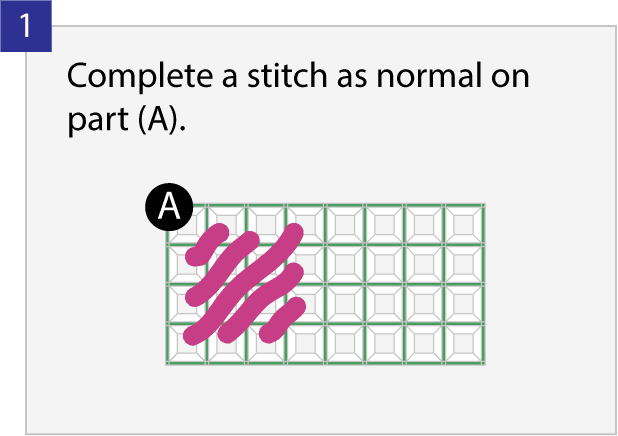
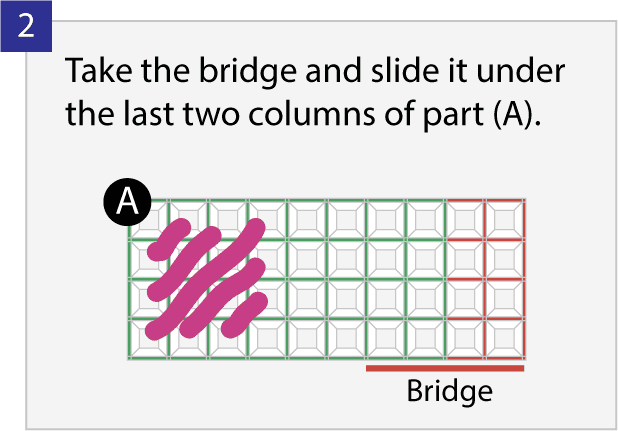
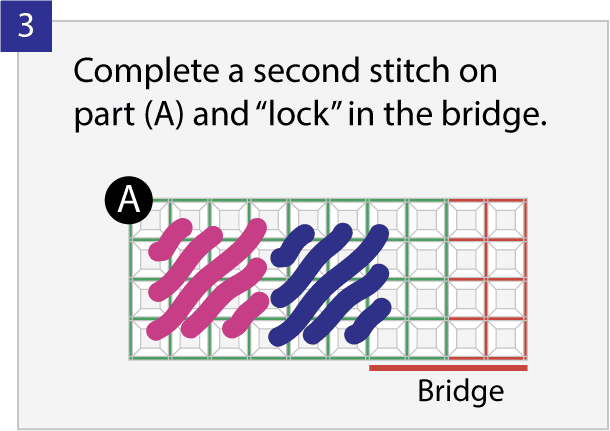
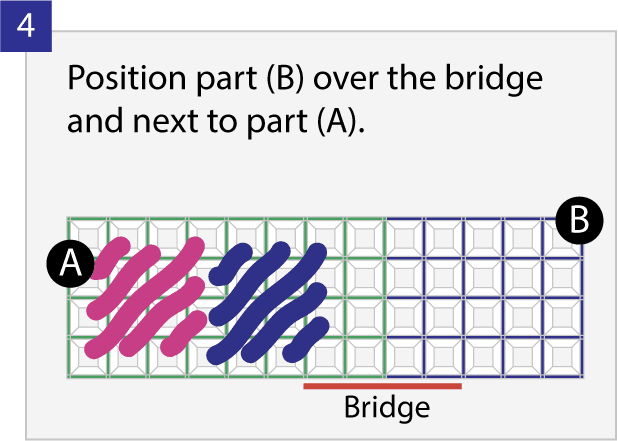
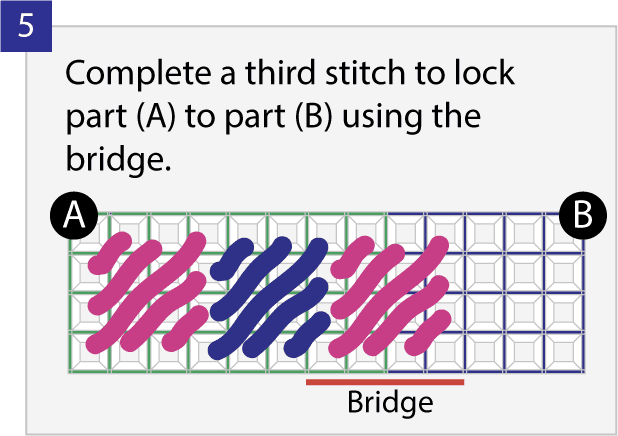
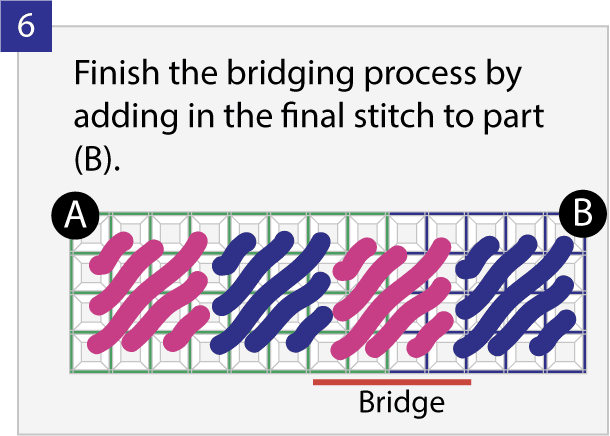
Follow the bridge sequence step by step to lock part A, the bridge, and part B together.
Step 5
Anchor yarn under previous stitches, add slight tension, and trim it so the end stays hidden.
Step 6
Wrap the outside edge of the canvas to hide exposed plastic and give the finished piece a clean border.
Step 1
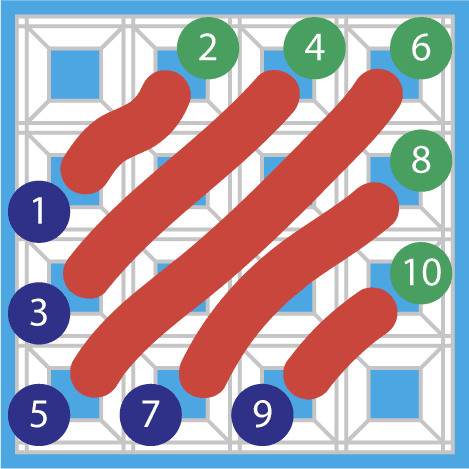
Our kits use this one specific stitch pattern throughout. It's a great way to fill in solid colors and give a uniform look. To use it, refer to the diagram on the right (fig. 3) and use the numbers to guide you through the pattern. The purple numbers (1,3,5,7,9) are stitched up from the back and the green numbers (2,4,6,8,10) are stitched down from the top.
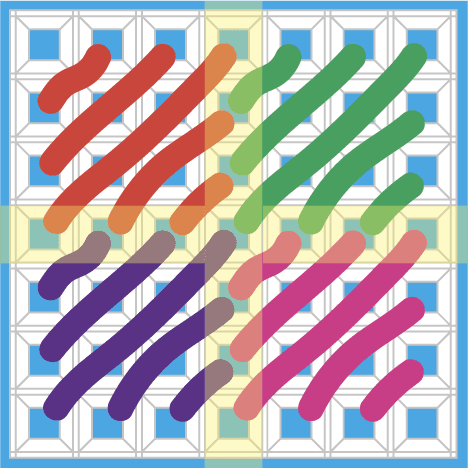
When you put two Scotch Stitches next to each other, you will be using the same holes for the adjoining side. See the yellow highlighted section on the image to the right (fig. 4). Make sure you don't leave a gap between stitches on the plastic canvas.
It's important to make sure not to leave any gaps between stitches on the plastic canvas.
Step 2
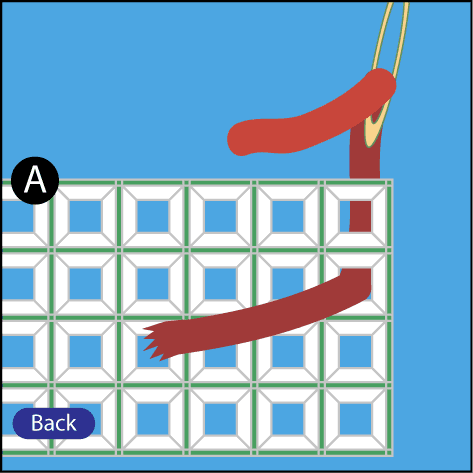
Now that your needle is threaded, you're ready to start a stitch on a new canvas. To do this, grab the plastic canvas piece (A) in your practice kit in one hand and your needle in the other hand, making sure the thread is secured.
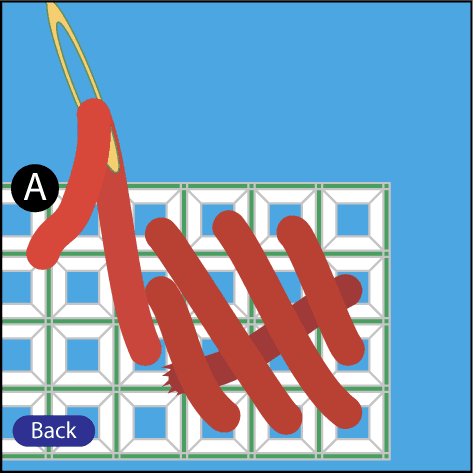
Using the Scotch Stitch pattern you learned (fig. 3) from the previous lesson, come from the back into the position (1) spot. Keep in mind that figures 5 and 6 are viewed from the back and figure 3 is viewed from the top.
Pull the yarn through and leave about a 1-inch tail on the backside of the canvas (fig. 5). Continue with your Scotch Stitch, making sure your stitching is covering the 1-inch tail to effectively lock in the yarn (fig. 6). Then, trim any excess yarn with the included scissors.
A helpful tip: if you're starting a Scotch Stitch next to a previous stitch, you can simply start the stitch by sliding your needle under a few stitches on the back side to lock it in.
Step 3
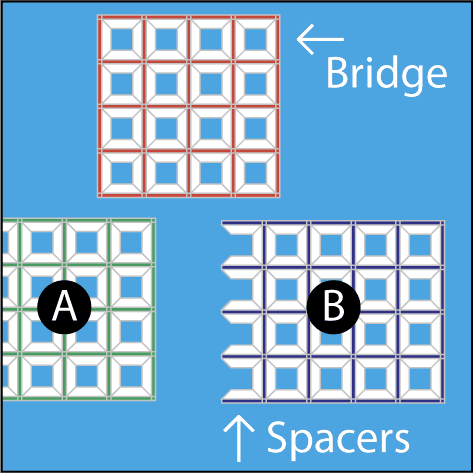
This practice kit uses a special technique called the "bridge system" to connect multiple pieces of plastic canvas together (fig. 7). This system makes it easier to work on larger projects and overcome the size limitations of plastic canvas.
Not all kits use the bridge system, but you can practice this technique using the practice kit. Follow the steps in the "Bridge Process Overview" to get started.
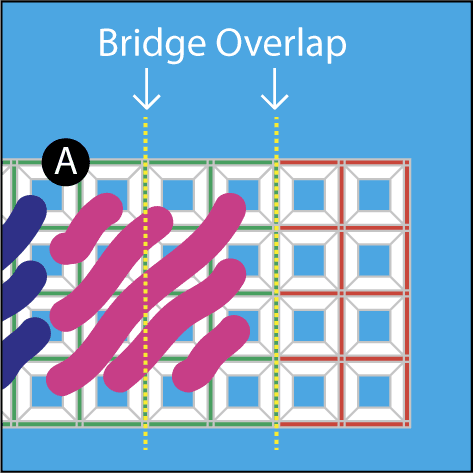
When using the bridge system, it's important to pay attention to the "bridge overlap" (fig. 8) and make sure not to stitch in this area until you're ready to connect the pieces. It's also important to make sure you're stitching on the correct side of the canvas, as it's easy to accidentally flip the design and prevent the pieces from matching up.
Step 4
Step 5
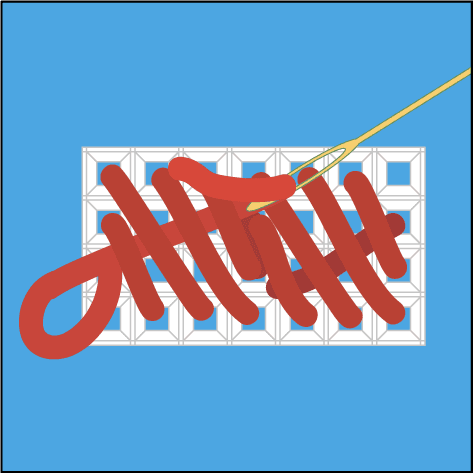
When you're running out of yarn or want to change colors, you'll need to end the current stitch and anchor it under previous stitches.
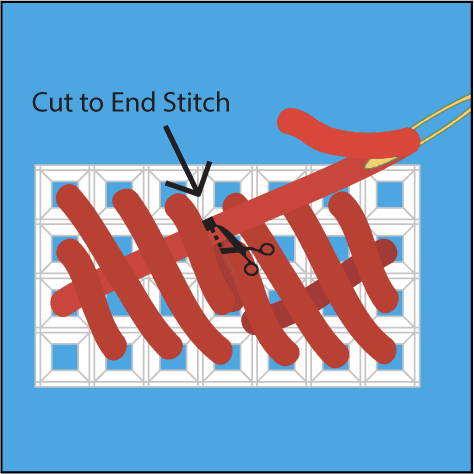
To do this, finish the current stitch as usual, then use the needle to guide the yarn under your previous stitch (fig. 9). Then cut the yarn to lock the stitch in place (fig. 10).
A helpful tip is to put slight tension on the yarn before cutting it. This will help the cut piece slide under the previous stitch, creating a cleaner appearance.
Step 6
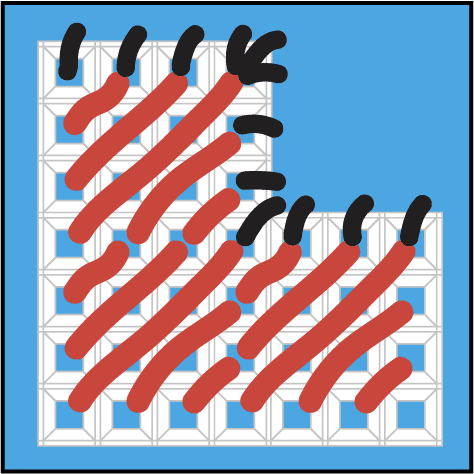
The "Overcast Stitch" is a technique used to cover up the plastic canvas edges on the sides of your design. This will give your piece a clean and finished look and helps stabilize kits that use plastic canvas bridges.
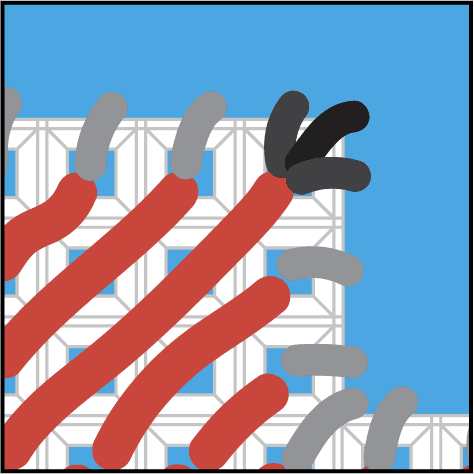
The pattern on the right (fig. 11) will show you how to apply the Overcast Stitch to flat sides and corners. You start and stop an Overcast Stitch in the same way you do a Scotch Stitch.
Make sure to do 3 wraps per corner (fig. 12) to help hide the plastic canvas from the corners.
To finish your practice kit, use the Overcast Stitch around the entire border.
Tip
You can also make smaller versions of a plastic canvas pattern by stitching on 10-count or 14-count plastic canvas with embroidery floss.
Use 6-strand embroidery floss on 10-count plastic canvas and 3-strand embroidery floss on 14-count plastic canvas. Work the design with a basic cross stitch technique to scale the pattern down.
These smaller versions are great for collecting, experimenting with color, and using the wide range of embroidery floss colors available.